

Infrastructure Investments: A High-Potential Asset Class Debuts at EXPO REAL
Infrastructure investments are gaining momentum. Discover how real estate and infrastructure are converging and explore the investment opportunities across the broad spectrum of infrastructure.

Key Points at a Glance
A Distinct Asset Class
Infrastructure investments fund facilities that keep the economy and society running, and the line between them and real estate is blurred.
Many Ways to Invest
Investors invest through project development, infrastructure funds, or public-private partnerships (ÖPP).
Opportunities and Risks
Stable, predictable cash flows and diversification are offset by illiquidity, tied-up capital, and regulatory and political risks.
Location Factor
Modern infrastructure enhances the appeal of locations and increases the value of real estate, including existing properties.
Drivers
Decarbonization and ESG, the energy transition, and digitalization—along with the growing demand for data centers—are shaping the market.
Real estate and infrastructure are still widely regarded as separate market segments. In practice, however, the two are becoming increasingly interconnected, with the boundaries between real estate and infrastructure investments continuing to blur. Both are real asset investments characterised by long investment horizons, high capital intensity and cash flows that can often be linked to inflation through long-term contracts and indexation mechanisms.
Infrastructure is also far more diverse than many assume. It is no longer limited to steel and concrete. Technological advances, in particular, have significantly increased the importance of energy and digital infrastructure in recent years. According to global management consulting firm McKinsey, around USD 106 trillion will be required worldwide by 2040 to build, modernise and maintain roads, railways, utilities and other critical infrastructure. In Europe alone, infrastructure investment is expected to exceed USD 13 trillion over the same period.
This creates a growing market for investable infrastructure, offering new opportunities for investors, financiers and project developers. At EXPO REAL, these market participants come together to explore markets, projects and investment opportunities at the intersection of infrastructure, real estate and investment.

What are infrastructure investments?
Infrastructure investments are investments in facilities that ensure the functioning of the economy and society. A broad distinction can be made between technical infrastructure and social infrastructure.
Technical (often also referred to as economic) infrastructure includes, on the one hand, transportation (roads, railways, ports, airports) and, on the other hand, energy and utilities (generation, grids, water). A large portion of the investment needs lies in energy infrastructure. In Germany alone, an estimated 650 billion euros will be needed by 2045 for grids, storage facilities, charging infrastructure, and renewable energy generation, according to a study by the research institute Frontier Economics commissioned by the German Chamber of Industry and Commerce (DIHK).
At the same time, the field of digital and communications infrastructure is becoming increasingly important. This includes fiber-optic networks, cell towers, and data centers. Driven by the demand for data centers resulting from cloud computing and AI, this digital infrastructure in particular has grown so significantly in recent years that it is now often cited as a third pillar in its own right.
Social infrastructure primarily includes health care facilities (hospitals) and educational institutions (universities, schools, daycare centers, as well as libraries, museums, and other cultural institutions). Internal security agencies (police, fire departments) are also considered part of social infrastructure.
Defense plays a special role as a segment that has gained increasing attention in response to recent geopolitical crises and conflicts. Germany alone is investing more than €100 billion in military infrastructure through its special defense fund. In the years ahead, Europe’s security will depend largely on its ability to modernize and finance critical infrastructure. At EXPO REAL, the focus is on physical infrastructure, including logistics facilities, cyber defense and data centers, as well as civil-military interfaces.
For a long time, the planning, construction, and maintenance of infrastructure facilities were considered a government responsibility as part of public services and were financed by tax revenues.
When people talk about infrastructure investments today, they are referring less to public investments (tax dollars) and more to investments by private investors, who are playing an increasingly significant role in financing infrastructure projects. While infrastructure assets managed by private investors stood at $500 billion in 2016, McKinsey reports that they will climb to approximately $1.5 trillion by the end of 2024—and the trend is still rising.

Infrastructure Financing—Opportunities and Key Players
The range of infrastructure projects is as broad as the range of opportunities to invest in or finance such projects. Many social infrastructure facilities are created as “standard” project developments or are part of a larger project. For example, a larger neighborhood development usually includes plans for a daycare center and a sports field. Whether it’s an office building or a residential development—a charging station for electric cars is now almost a given. In these cases, it’s usually the project developers themselves who plan for the necessary infrastructure.
Infrastructure Funds as Sources of Capital
Other infrastructure projects, on the other hand, require a significant capital investment that is often beyond the means of individual investors. One option is infrastructure funds, which are frequently launched by capital management companies—including independent asset managers and the asset management divisions (fund companies) of major banks. Infrastructure funds can be structured as open-ended public funds, but are usually launched as closed-end special-purpose funds for institutional investors (insurance companies, pension funds, sovereign wealth funds, and foundations). These funds then invest in companies that build infrastructure (project financing) or in companies that manage infrastructure or supply key components for it (financing of existing infrastructure assets).
Public-Private Partnerships (PPPs)
As public sector financial resources become increasingly scarce while the need for infrastructure investment remains high, collaboration between the public and private sectors within the framework of a public-private partnership (PPP) is gaining importance.
Originally, PPPs were primarily a form of collaboration for the joint implementation of projects, with private partners usually involved only for financing purposes. Now, however, private partners are also involved in planning, undertake construction or renovation as well as operation and maintenance, and, if necessary, handle the sale of the asset at the end of its public use. Consequently, today the term PPP is used exclusively to refer to arrangements in which the private partner assumes responsibility for at least three of these life-cycle phases of an asset. During the asset’s operational life, the public sector pays the private partner a regular fee—usually agreed upon in advance—for its services. In addition, the service may also be financed in whole or in part by user fees or charges.
Cooperation Among Stakeholders
The advantage of this model is that it takes into account the entire life cycle of an infrastructure project from the very beginning. The integrated approach to construction, operation, and risk management offers a significant efficiency advantage and leads to the implementation of high-quality and economically sustainable solutions from the very beginning. In principle, the public sector remains the owner of the infrastructure facility but benefits from the private partner’s expertise, capacity, and efficiency.
Examples of PPP Infrastructure Projects
Examples of infrastructure projects implemented under PPP terms can be found in all federal states, as well as in cities and municipalities.
- Utility and waste management infrastructure: Waste disposal facilities that not only empty trash bins but also operate the necessary facilities.
- Transportation infrastructure: Investments in airports and ports through operating companies.
- Energy infrastructure: Wind farms and large solar power plants that owe their existence or expansion to private-sector investment.
- Digital infrastructure: the expansion of the fiber-optic network.
- Social infrastructure: including smaller-scale projects, such as the expansion of the Dellbrücker Mauspfad comprehensive school in Cologne with Hochtief PPP Schulpartner Köln P1—the private partner handled the planning, construction, operation, and maintenance of the passive house building.

What opportunities and risks do infrastructure investments present?
On the one hand, the opportunities lie in portfolio diversification. Historically, infrastructure has shown a low correlation with equity and bond markets. In terms of portfolio construction, this means it offers genuine diversification rather than merely supplementing returns. On the other hand, investments in infrastructure projects provide stable returns. Long-term contracts ensure predictable cash flow. Because a large portion of the revenues is typically linked to price indices, this asset class can act as a structural hedge against inflation within the portfolio.
Unlike publicly traded stocks, the returns on infrastructure investments are also less volatile, as infrastructure is always needed. It serves as a basic public service and is relatively independent of short-term market cycles. Risks include the long-term commitment of capital and the market’s illiquidity, which reduce flexibility.
Infrastructure investments are not only capital-intensive but also typically require significant financing. Rising interest rates—and the resulting increase in financing costs—can negatively impact profitability.
Similarly, changes in the regulatory framework (laws, regulations, tax policies) or political shifts can have a lasting impact on the economic success of an infrastructure investment.
At a Glance: The Opportunities and Risks of Infrastructure Investments
Opportunities
- Portfolio diversification due to low correlation with other asset classes
- Long-term capital commitment
- Higher financing requirements
- Less competition
- Greater independence from market cycles
Risks
- Stable, predictable returns
- General conditions
- Market illiquidity
- Impact of natural disasters
How does infrastructure affect real estate and locations?
Real estate and infrastructure are two asset classes with many similarities and blurred boundaries. What is a data center? A piece of real estate or an infrastructure project? Anyone developing a neighborhood today will have no choice but to include a daycare center in their plans. Similarly, it’s not enough to simply create parking spaces; with the rising number of electric cars, appropriate charging stations are also needed. In the age of digitalization, a fiber-optic connection is almost a given. And no one will move into a neighborhood that’s far from any supermarket, doctor’s office, schools, or sports facilities. For any real estate project, success requires a close look at the entire technical and social infrastructure. If you’d like to learn more about real estate as an asset class, you’ll find additional information on the page about real estate investment.
Infrastructure as a Factor in Location Attractiveness and Value Appreciation
A well-functioning, modern infrastructure is an important location factor on both a small and large scale, and applies equally to real estate developments as well as to cities and municipalities. A modern, well-functioning infrastructure increases a location’s attractiveness and also leads to value appreciation for individual properties; in the case of municipalities, it increases the willingness of project developers and investors to get involved there. For project developers and investors in particular, the existing infrastructure thus becomes a key criterion in their choice of location.
Potential for Value Appreciation Even in Existing Properties: Especially for older properties, additional investments in improved infrastructure offer potential for value appreciation. Whether it’s charging infrastructure for electric cars, rooftop PV and solar systems, or bike parking spaces where e-bikes can also be charged—these are just a few examples of how the value of many existing properties can be increased. The development of social infrastructure facilities in more monofunctional neighborhoods can also counteract declining attractiveness and the resulting loss of value.
What trends are currently shaping the market for infrastructure investments?
Even though these terms seem to have taken a back seat in the discussion, they continue to shape future developments (not only) in the real estate industry: climate protection (decarbonization), sustainability, and ESG. Other drivers include increasing digitalization and technological advancements.
- Digitalization and Data Centers: Growing volumes of data are driving the expansion of fiber-optic networks and data centers, the demand for which continues to rise as AI applications become more widespread.
- Rising energy demand: This goes hand in hand with growing electricity demand, which—for climate protection reasons—should be met less and less by fossil fuels.
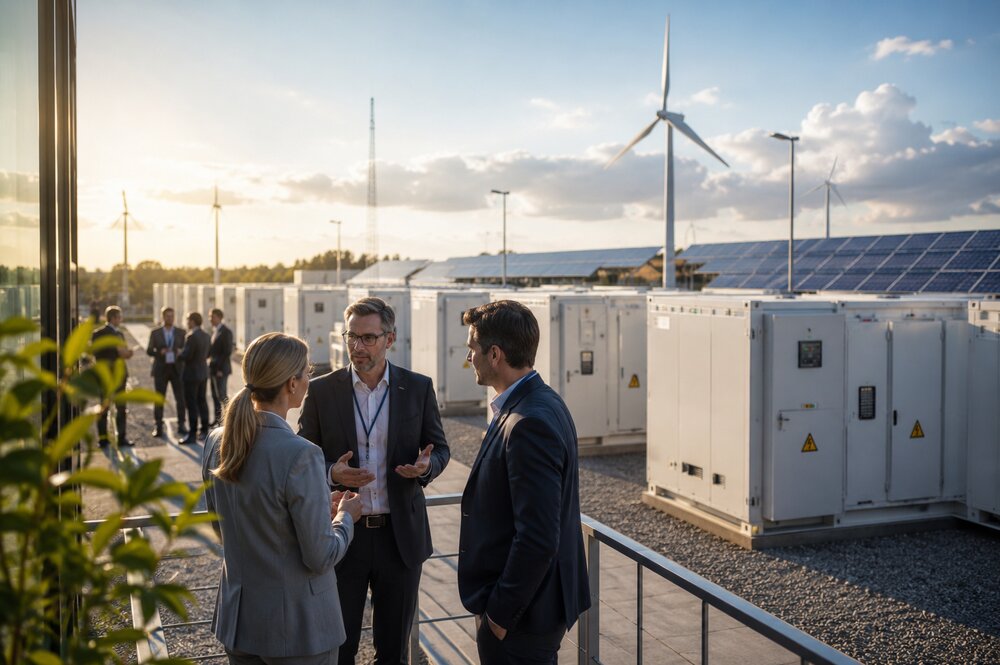
- Renewable Energy and Grids: The transition requires the expansion and retrofitting of power grids, as well as additional storage capacity, such as battery storage or hydrogen-based backup power plants.
- Decarbonization and ESG: CO₂ emissions are to be reduced by at least 65% by 2030 compared to 1990 levels and brought to zero by 2045. The “E” in the ESG criteria (Environmental, Social, and Governance) in particular commits companies to these goals.
What can you expect to see at EXPO REAL regarding infrastructure investments?
EXPO REAL in Munich is the international trade fair for real estate and investment, where the key players in the infrastructure market come together: investors and funds, project developers, as well as financiers and institutional investors. Here, market participants gain an overview of investable infrastructure projects, network, and initiate business deals. Expert presentations, panel discussions, and debates address the most important topics—from investment and financing to ESG, energy, and digitalization.
Conclusion
Infrastructure investments are increasingly becoming a key asset class for institutional investors. EXPO REAL in Munich offers the ideal platform for understanding markets, infrastructure projects, and investment opportunities, as well as for meeting relevant infrastructure investors and partners.
Frequently Asked Questions (FAQ)
Through mostly long-term contracts in regulated markets that provide predictable and, in some cases, inflation-protected cash flows—for example, from usage fees, charges, or fixed payments from the government.
Infrastructure functions as a distinct asset class, typically exhibiting low to moderate correlation with stocks and bonds, and thus contributes to diversification and the smoothing of return profiles, supplemented by what is often partial protection against inflation through indexed or regulated revenue streams.
Particularly in energy infrastructure and power grids, in digital infrastructure such as fiber optics and data centers, and in the modernization of existing transportation and utility networks.
The spectrum ranges from energy and transportation projects to digital infrastructure and social facilities, and is presented by investors, developers, and financiers.
Through the exhibitor directory, targeted networking on-site, and the expert presentations and panel discussions on infrastructure and financing.