
Hotel properties: trends & developments
How is the market for hotel properties developing? What are the trends in the global hotel industry? Europe's largest trade fair for hotel properties and investment players from the hotel and real estate industry meet to discuss current developments and establish important contacts.

Das Wichtigste in Kürze
- Rising Demand: Hotel real estate is once again gaining prominence among investors in Europe.
- A Popular Asset Class: Investors Continue to Bet on Hotels—as a Long-Term, Largely Inflation-Resistant Investment.
- Segment and Brand Trends: Capital is flowing specifically into the upscale segment, into strong brands, and into flexible formats such as serviced apartments and branded residences.
- Sustainability & AI as Value Drivers: Building conversions, ESG, and artificial intelligence are increasingly shaping the industry’s development.
- Major Challenges: Rising construction costs and geopolitical risks remain the key issues.
EXPO REAL – the ideal platform
The diversity of participants and topics in the hotel real estate market makes EXPO REAL the ideal platform
- for authoritative information on all aspects of hotel real estate—from the purchase and sale of land to real estate investments across the entire hospitality industry—
- as well as for meetings and discussions with leading players in the international hotel real estate market.
- for productive meetings with hotel experts, developers, investors, and service providers in the hotel real estate sector. They all use EXPO REAL as an information-rich trade show and a meeting place.
What is the current trend in the hotel real estate market?
The European hotel real estate market is once again seeing high levels of activity in 2026: According to Cushman & Wakefield, approximately 11.7 billion euros were invested in hotel real estate in Europe during the first half of the year—about 20 percent above the ten-year average. Investors are taking a selective approach, focusing on a small number of large, high-quality properties. London and Barcelona top the list of preferred cities, while Spain is considered the most attractive country for hotel investments.
According to a study by real estate consulting firm Savills, operational performance is becoming an increasingly important factor in investment decisions as the gap between average and top-tier operators widens.
Why Invest in Hotel Real Estate?
Investing in hotel real estate is worthwhile because investors benefit from structurally growing demand for travel and combine recurring income with the potential for appreciation. One advantage over most other real estate asset classes is that, since operators can adjust their prices daily based on market conditions, hotels act as a hedge against inflation and offer a reliable source of income.
Investor confidence is correspondingly high: According to CBRE’s “European Hotel Investor Intentions Survey 2026,” more than 90 percent plan to maintain or increase their investments in 2026. This confidence is driven by the sustained growth of the travel and tourism sector, the robust business performance of the hotel industry, and the economic stabilization in Europe. Hotels are thus increasingly viewed as long-term strategic investments rather than merely cyclical opportunities. Investors continue to focus on a mix of established gateway cities and high-performing vacation destinations in Southern Europe and the core markets.
What does the future hold for the hotel real estate sector?
The future of the hotel real estate sector is shaped by three trends: greater sustainability, higher quality, and more flexible usage concepts. Many hotels have been implementing environmentally friendly measures for years. Sustainability is no longer merely an operational issue: According to the CBRE “European Hotel Investor Intentions Survey 2026,” it is increasingly factored into pricing and investors’ management strategies. To achieve today’s climate goals, professional operators and long-term, responsible investors must join forces. Only in this way can high-quality properties with flexible usage continue to be financed in the hotel real estate market and successfully established in a market that remains highly competitive, where trends are significantly influenced by the needs of consumers and travelers.
What solutions are available, and how can this transformation be accelerated? Does it open up new investment opportunities in hotel real estate? At EXPO REAL, you’ll benefit from the expertise of experienced professionals and hospitality consultants.

What are the current trends in hotel real estate?
Current trends in the hotel real estate sector include a clear focus on the upscale segment, brand-led concepts, flexible, home-like formats such as serviced apartments and branded residences, and the rapid rise of artificial intelligence as a value driver. This development is driven by changing travel behaviors—longer stays, hybrid work, and the desire for greater residential comfort.
Branded residences are experiencing particularly dynamic growth: According to the Savills Branded Residences Report 2025/26, branded residential properties command a 33 percent premium on average worldwide compared to comparable unbranded properties—and as much as 39 percent in vacation destinations. The brand is also gaining importance in traditional hotels: In the CBRE survey, investors’ preference for internationally recognized hotel brands rose to 53 percent, up from 43 percent in the previous year’s survey. At the same time, capital is flowing specifically into the upscale segment: According to Cushman & Wakefield, approximately half of the investment volume in Europe during the first half of 2026 was allocated to hotels in the upscale and upper-upscale categories.
Artificial intelligence (AI) is also emerging as a key topic for the future: According to the Cushman & Wakefield European Hotel Investor Compass 2026, 81 percent of investors expect AI to have a significant impact on the sector by 2030—most notably in the limited-service segment (86 percent), closely followed by full-service hotels (85 percent). Eighty percent anticipate that AI will reduce operating costs through efficiency gains, and 65 percent expect sales costs to decline due to an increase in direct bookings and reduced reliance on online travel agencies.
What are the biggest challenges facing the hotel real estate market?
The biggest challenges currently facing the hotel real estate industry are rising construction costs, as well as geopolitical and macroeconomic risks. Financing issues, on the other hand, are becoming less pressing.
According to the Cushman & Wakefield European Hotel Investor Compass 2026, 68 percent of investors view rising construction costs as a high or very high hurdle—and thus as the number one challenge. Geopolitical and macroeconomic risks follow in second place (53 percent), which are likely to gain even more significance due to the recent escalation in the Middle East. At the same time, concerns are shifting: financing issues have become significantly less important thanks to improved credit conditions—a 19 percent decline compared to 2025.
How the industry is addressing these challenges is one of the key topics at EXPO REAL 2026—in discussions with investors, operators, and experts from across the hotel real estate sector.
FAQ
Hotels are real estate properties that generate revenue through lodging and related services. Unlike residential or office properties, their returns depend directly on day-to-day operations, and room rates can be adjusted daily to reflect demand. This makes hotels a distinct, operator-dependent asset class that offers good protection against inflation.
The European market is once again characterized by high levels of activity: According to Cushman & Wakefield, approximately 11.7 billion euros were invested in hotel real estate in the first half of 2026. Investors are taking a selective approach, focusing on a small number of large, high-quality properties.
The upscale and upper-upscale segments, as well as luxury hotels, are currently in particularly high demand. There is also a growing focus on brand-led concepts and flexible, home-like formats such as serviced apartments, extended-stay hotels, and branded residences.
Four factors are key: Interest rates determine how affordable capital is; high construction costs are considered the biggest hurdle for new projects; ESG criteria are playing an increasingly important role in valuations and purchase prices; and the quality of the operator determines the ongoing income. After all, without a strong operator, even a good property will fail to reach its full potential.
Key factors include a focus on the upscale segment, strong brands, and flexible formats; the enhancement of the portfolio through conversions and ESG initiatives; and the rapid rise of artificial intelligence as a value driver for operating and sales costs.
At EXPO REAL, taking place October 5–7, 2026, in Munich, investors, operators, developers, and consultants from across the hotel real estate industry will come together. Visitors will gain firsthand insight into the trends shaping the market, make valuable connections, and discuss current challenges.
First-hand and purposeful information on hotel properties
From buying and selling hotels, investing in hotel properties, trends and prices to current hospitality topics—EXPO REAL is well worth a visit!
- Visit the booths of leading players in the hotel property market.
- Get to know the latest innovations in the hotel sector.
- Discuss current trends and challenges around hotel properties—from simple to luxury hotels—with experienced experts and practitioners.
- Maintain and expand your network and initiate new business relationships.
- Enjoy inspiring presentations and renowned speakers in EXPO REAL's high-profile conference program.

Renowned exhibitors in the hotel property sector of the EXPO REAL 2026
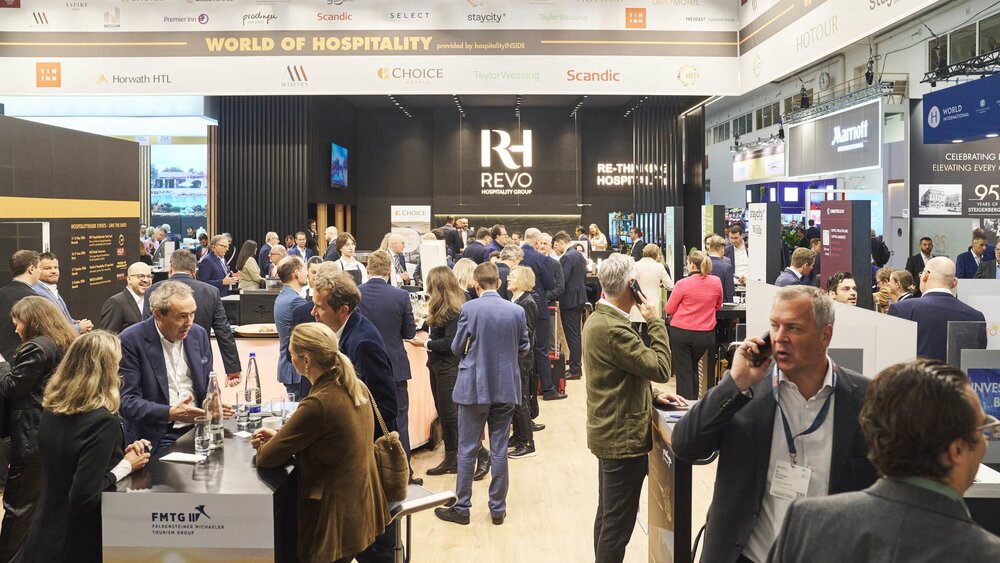
Which companies offer services in the hotel real estate sector? And who does what? Here you’ll find all the exhibitors at EXPO REAL 2026. In addition to the “World of Hospitality” and “196+ lounge” group booths, there are numerous individual booths from leading market players.
World of Hospitality—Hotel industry in 360°
Since 2011, the joint pavilion “World of Hospitality” has been one of the first destinations for trade fair visitors interested in hotel properties: it features domestic and foreign exhibitors from the entire value chain, from investors to hotel operators. This is where you will find contacts across the entire spectrum of the hotel property market: search for locations, hotel buildings, hotel development, prices and financing, investment in hotel properties and operation of hotels.

The following companies from the hotel real estate market, among others, will be represented at the booths:
- Choice Hotels
MASEVEN Serviced Apartments & Aparthotels - TUI Hotels & Resorts
- Novum Hospitality
- Premier Inn Holding GmbH
- and many more exhibitors.
- Choice Hotels
The 196+ lounge—hot spot for the hospitality industry
Current topics, effective networking: PKF hospitality group, the parent company of 196+ Events, stands as an internationally recognized leader in hotel, serviced living, tourism and leisure consulting. Being a joint pavilion, the 196+ lounge brings together the leading hotel groups and players in the hospitality industry. Thus, EXPO REAL offers you a varied platform for relaxed networking in the market for hotel properties.
Hospitality Industry Dialogue: hotel properties on the conference stage
The conference program at EXPO REAL 2026 covers a wide range of topics in the real estate industry related to the hospitality sector:
- Serviced Apartments & Branded Residences—Where Is the Greatest Potential?
- German Hospitality Real Estate: Pitfalls Despite Historically High Room Rates?
- and many more.
A visit to EXPO REAL is most definitely worthwhile, as this is where the key players in the entire life cycle and all aspects of hotel properties meet. The perfect opportunity to learn first-hand about the trends that are shaping the international hotel property market. You will benefit from the extensive know-how of reputable companies from the hospitality industry and can establish useful business contacts.
Impressions of EXPO REAL