

Decarbonization of real estate: all the news on the future of buildings at EXPO REAL

Decarbonizing buildings—one of the major topics at EXPO REAL
Climate change has become noticeable, and it is inevitable to contain global warming. Rising temperatures are mainly attributable to the emission of carbon dioxide (CO₂), which is produced when fossil fuels are burned. On the list of polluters, buildings and transport rank third and fourth (after the energy sector and industry). Along the path to a climate-neutral city, the goal is to cut CO₂ emissions from buildings by about half by 2030 and to make buildings completely climate-neutral by 2050. These real estate decarbonization goals can only be achieved by innovative solutions in their construction, renovation and operation.
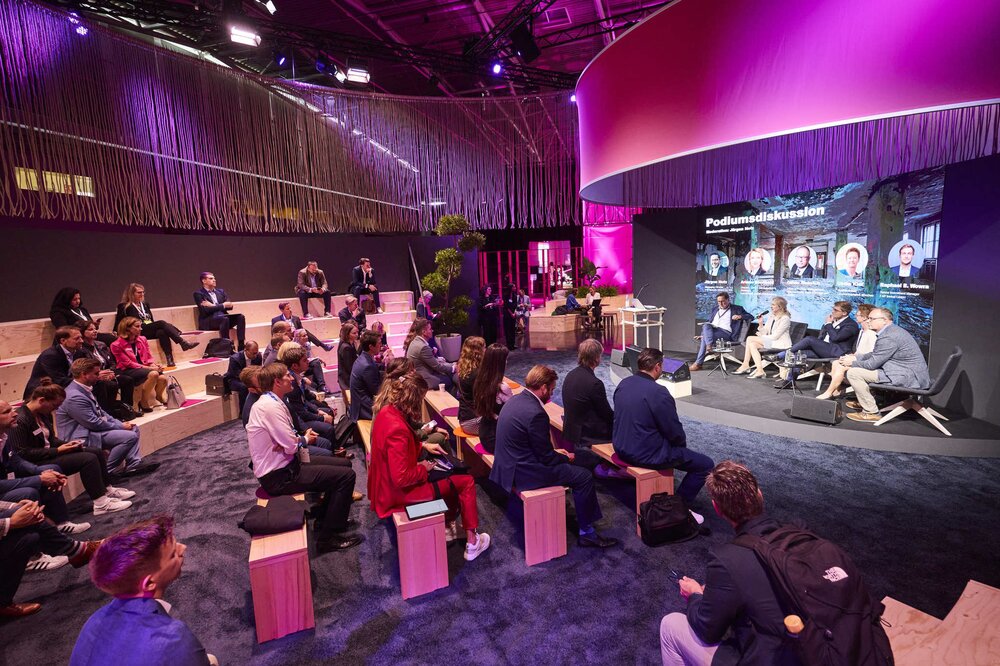
The decarbonization of cities and buildings will be addressed this year at Transform & Beyond by EXPO REAL, along with many other future topics.
What does decarbonization mean?
Decarbonization refers to the reduction of carbon dioxide emissions (CO₂ emissions) through the use of low-carbon or—better yet—carbon-free energy sources. Carbon-free energy sources include renewable energy sources such as wind, solar, geothermal, hydropower, and biomass. Wood is also a renewable energy source; however, when burned, it releases the CO₂ that was once stored within it. The goal of decarbonization is to limit climate change and curb global warming. The aim is to limit global warming to well below 2° Celsius—by 2026, we are projected to already be 1.6° Celsius above pre-industrial levels.
Since the entire economy and our modern way of life depend on energy use, virtually all sectors are affected by the transition to climate-neutral energy use. The real estate industry, too, is called upon to make energy use in buildings and properties climate-neutral.
Decarbonization of Real Estate
According to the Federal Ministry for the Environment, the building sector accounts for 16 percent (about 120 metric tons) of total CO₂ emissions in Germany. However, this calculation includes only the emissions generated during the operation of the building—that is, from heating, cooling, hot water production, and the consumption of electricity for lighting, household appliances, and other in-home technology. If we add the so-called “gray energy” required to construct a building—which is largely attributed to the industrial sector—the construction and building sector’s share of CO₂ emissions rises to 36 percent.
To start with the operation of buildings: For new construction, the increasingly stringent requirements of the Energy Conservation Ordinance—and, since 2020, the Building Energy Act—have led to relatively high energy efficiency in the operation of these properties. The far greater challenge is the energy-efficient retrofitting of existing buildings. In 2022, there were approximately 19.7 million residential buildings in Germany, 63 percent of which were built before 1979 (when the first Thermal Insulation Ordinance took effect). There are approximately 3 million non-residential buildings ( office properties, hotels, logistics facilities, production sites, sports arenas, churches, schools, supermarkets, etc.) in Germany, 14 percent of which were constructed in the last 15 years. In other words, the vast majority of buildings require energy-efficiency retrofits if CO₂ emissions from building operations are to be sustainably reduced.
Renovation of Existing Properties
In recent years, little progress has been made in Germany regarding the retrofitting of existing buildings. About 40 percent of residential buildings fall into energy efficiency classes E and F and are therefore in need of retrofitting. The rate of energy-efficiency retrofits remains well below 1%, but it would need to be more than twice as high to meet climate targets—the building stock is supposed to be climate-neutral by 2045. In 2025, for example, only about 260,000 residential units underwent energy-efficiency retrofits—at least 460,000 units per year would be necessary.
Energy-efficient renovation primarily means ensuring that buildings have the lowest possible heating requirements. The main measures involve improving the airtightness of windows and doors and insulating the building envelope so that less heat escapes from the interior spaces. This also involves reducing energy consumption (hot water, electricity) through solar and photovoltaic systems and relying largely on non-fossil fuel energy sources for heating during the cold season. In addition, control systems can regulate the heating demand in individual rooms, thereby also contributing to energy savings.
Decarbonization: The Path to a Climate-Neutral City
Sustainable decarbonization must begin in cities. These areas account for about 80 percent of global CO₂ emissions. This is due not only to building density—after all, 75 percent of EU citizens live in urban areas—but also, among other factors, to transportation and mobility, as well as manufacturing and industry. At the same time, it is in cities that the effects of global warming are felt most acutely. One goal of the EU’s climate policy is therefore to reduce climate-damaging emissions in cities by 55 percent by 2030 and to achieve climate neutrality by 2050. For this reason, the European Commission is supporting 100 cities on their path to becoming climate-neutral and smart by 2030 (netzerocities.eu). These cities are then intended to serve as role models for all other European cities.
This doesn’t just mean more buildings that are as climate-neutral as possible; it also means changes in urban mobility. In this context, there is often talk of the “15-minute city,” where people can reach all essential amenities—shops, parks, restaurants, cafés, post offices, doctors’ offices, schools, train stations, and, if possible, workplaces—within 15 minutes on foot, by bike, or by public transportation. This represents a shift away from the city with a single central hub—where more or less everything is concentrated—toward a polycentric city.
Challenges and Opportunities of Decarbonization
In light of climate change, reducing CO₂ emissions is essential, and greater efforts are needed to achieve the goal of cutting these emissions in the existing building stock by a good half by 2030. The recent political back-and-forth surrounding the Building Energy Act (GEG) has had a dampening rather than a stimulating effect. Added to this is the economic situation—the real estate industry is suffering from rising financing costs, a shortage of skilled workers, and inflation, which is driving up construction and renovation costs. According to estimates, these costs range from 600 to 1,800 euros per square meter of living space, depending on the standard chosen and the extent of the renovation required. There are corresponding subsidies available, but they do not fully cover the costs. The question is also which measures are truly worthwhile—that is, particularly efficient—decisions that must be made on a case-by-case basis. Insulating the exterior facade alone yields a 19 percent energy savings, while replacing the windows yields about 7 percent. Together, these two measures already reduce energy consumption by a quarter. If you also insulate the roof/upper floor slab and the basement, the energy savings amount to more than one-third. And the better a building is insulated, the more feasible it is to use a largely climate-neutral heating system such as an air-source heat pump.
Even though the cost of such measures may seem daunting to some at the moment, it is also clear that buildings that have not undergone energy-efficiency renovations will lose significant value in the foreseeable future. Measures to reduce CO₂ emissions therefore not only help the climate; they also increase a property’s value and prevent value loss in the medium and long term.
EXPO REAL Visitor Information
Stay up to date with our EXPO REAL visitor information! Simply subscribe and never miss any news again.